

In this article
Type grammarvista.com into a search bar and you will get a mix of results that don’t quite agree with each other. Some describe it as an English grammar resource. Others talk about a grammar-checking tool. A few pages don’t look like they have anything to do with grammar at all. So which is it — and can you trust what you find there?
That confusion is exactly why this guide exists. Below, we break down what GrammarVista.com actually is, what it publishes, how it differs from the similarly named grammar tools that keep showing up in the same search results, and whether the site is legitimate. If you landed here because you’re thinking about using it for study, teaching, or improving your own writing, you’ll leave with a clear picture.
In this article
What Is GrammarVista.com?
GrammarVista.com is an informational website that presents itself as a resource for English grammar, vocabulary, writing, punctuation, and general language guidance. Its own About page describes the site’s goal as making English easier to understand through straightforward explanations and practical examples — the kind of content you read, not the kind of software you install.
The site’s welcome message sets the tone plainly: it offers guidance on grammar and vocabulary to help visitors refine their writing skills, whether they are polishing professional documents or working on personal projects. The emphasis, at least as stated, is on tips and corrections that lead to clearer, more effective communication.
That framing matters, because a lot of people arrive at GrammarVista.com expecting a tool. The name sounds like software — something you paste text into and get corrections back. In reality, the site is closer to a digital magazine about the English language: articles and guides you read, learn from, and apply on your own. Understanding that distinction up front saves a lot of confusion, and we will return to it in detail below because it is the single most common misunderstanding about this domain.
It is also worth noting what the site is not trying to be. It does not position itself as an academic publisher, a dictionary, or a language certification body. It sits in the broad middle of the internet’s “explain English to me” space — the same neighborhood as the countless blogs and reference sites that answer questions like when to use “its” versus “it’s” or how American and British spelling conventions differ. Some of those sites are excellent; some are thin content farms. The question is where GrammarVista.com falls, and that depends on which page you land on.
What Does GrammarVista.com Publish?
The site’s stated subject areas cover the core of English language learning. According to its own descriptions, GrammarVista.com focuses on:
- English grammar rules and sentence construction — the structural basics of how sentences are built.
- Punctuation and capitalization — commas, apostrophes, quotation marks, and the rules that govern them.
- Vocabulary and word meanings — what words mean and how to use them correctly.
- Commonly confused words — the classic trouble pairs like their/there/they’re or affect/effect.
- Apostrophes and possessive forms — one of the most searched-for pain points in written English.
- Compound words and spelling — when words join, split, or hyphenate.
- American English usage — with particular attention to US spelling, punctuation, and vocabulary conventions.
- Academic and professional writing — tone, clarity, and correctness for school and work.
- Everyday language questions — the small doubts that come up while writing emails, posts, and messages.
The American English angle deserves a special mention because it appears to be one of the site’s signature themes. Multiple pages frame the content around American conventions — spelling differences, punctuation preferences, and vocabulary choices that matter when writing for US audiences — while still acknowledging British English rather than treating it as incorrect. For students, job seekers, and freelancers writing for American clients, that orientation is genuinely useful, since mixing conventions is one of the fastest ways to make a document look unpolished.

Grammar guides like the ones GrammarVista.com publishes work best when you study them actively instead of just skimming the rules.
Here is where things get a little more complicated. The site’s current publishing scope extends well beyond grammar. Its homepage and tag archives include articles about broader subjects — technology, business, health, and other general-interest topics. This is a common pattern with content sites: they start with a focused niche and then expand into whatever draws search traffic. It does not automatically make the grammar content bad, but it does mean you should judge each article on its own merits rather than assuming every page is a dedicated language lesson.
A practical consequence: if you arrive from a search result about, say, business ideas, you are reading a general-interest article that happens to live on a grammar-branded domain. The grammar expertise implied by the name does not automatically transfer to every topic the site covers. Read the specific article, check whether it explains things clearly and accurately, and don’t let the domain name do the thinking for you.
GrammarVista.com vs Grammar-Checking Tools: Clearing Up the Confusion
This section could save you the most time, so let’s be blunt: GrammarVista.com is not the same as Grammervista.com. The two domains differ by a single letter, and they are different websites.
Grammervista.com — spelled with one “m” in the middle — is a browser-based grammar-checking service. It offers the kind of tools you would expect: grammar and spelling checks, clarity suggestions, readability analysis, and word counting. If you are looking for a place to paste your essay and get corrections, that is the kind of site you are probably thinking of.
GrammarVista.com — with the double “m” — is the content site described above: articles and guides about English, not an interactive checker. Searching for one will regularly surface the other, and third-party guides about the domain explicitly warn readers to check the exact web address before assuming a particular feature belongs to it.
There are other near-neighbors in the search results too, including similarly named grammar resource sites on different domains. The takeaway is simple and worth repeating: when you search for any “grammar vista” style name, look at the actual URL in your browser’s address bar before you decide what you are dealing with. A content site and a checking tool serve completely different purposes, and reviewing one as if it were the other leads to unfair conclusions in both directions.
Why does this confusion persist? Partly because the names are genuinely easy to mix up, and partly because both kinds of sites target the same audience — people who want to write better English. If you came here looking for a free online grammar checker, GrammarVista.com’s articles may still help you understand the rules behind the corrections your checker makes, but the site itself will not check your text for you.
How to Use GrammarVista.com Effectively
Used the right way, a site like GrammarVista.com can be a solid supplementary resource. Used the wrong way, it becomes just another tab you opened and forgot. Here is how to get actual value out of it.
Start with your real questions, not the homepage
The most useful way to use any grammar resource is problem-first. Instead of browsing the homepage hoping to absorb grammar by osmosis, arrive with a specific question: “Is it ‘who’ or ‘whom’ in this sentence?” or “Does this comma belong here?” Search the site for that exact topic. Articles written to answer one question tend to be clearer than general overviews, and you will remember the rule better because you needed it.
Learn the rule, not just the answer
The site’s own philosophy — explaining why one form is correct rather than just giving the correction — is the right instinct, and you should hold its articles to it. Take the classic its versus it’s problem. A lazy article tells you “it’s = it is.” A useful one explains that the apostrophe marks a contraction, shows you how to test it by expanding the sentence, and gives you a second example in a different context. When an article does that work, slow down and read the explanation, not just the bolded answer.
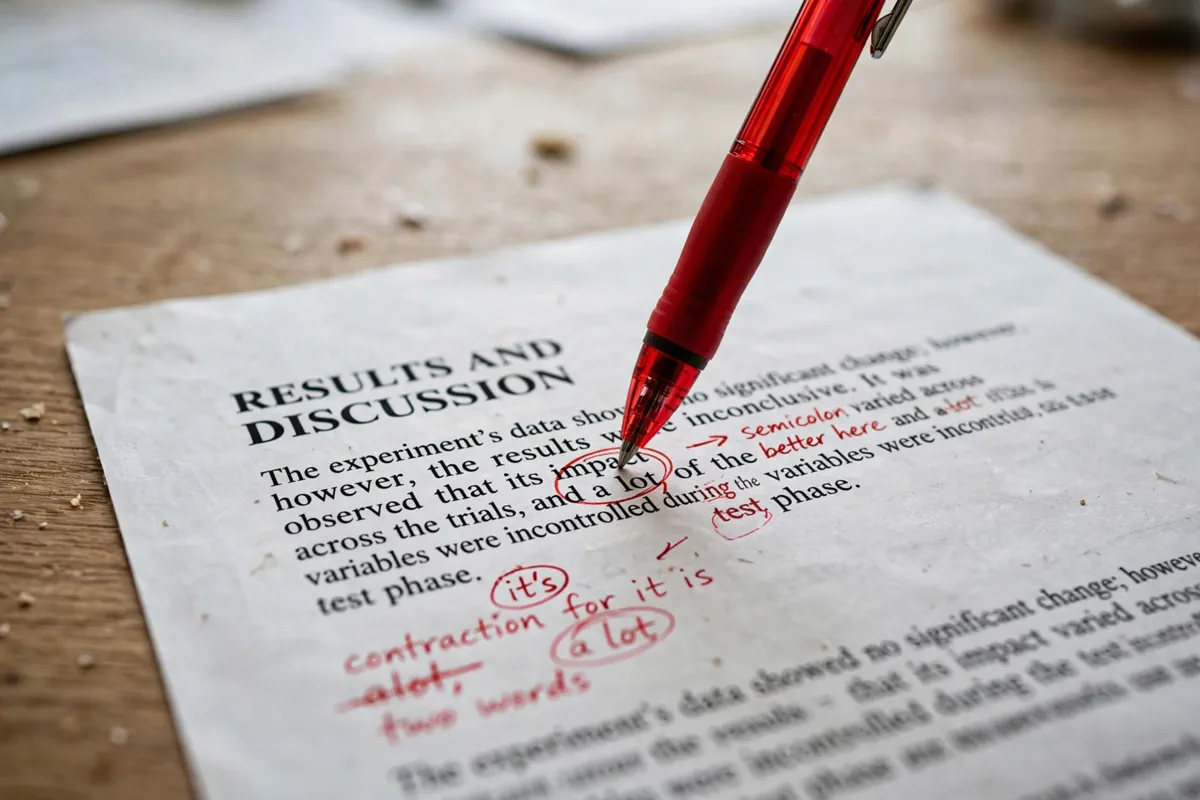
Punctuation corrections stick better when the explanation shows why one form is correct and the other is not.
Pair reading with practice
Reading about grammar does not improve grammar on its own — writing does. After reading an article about a rule you struggle with, write five sentences using it deliberately, then check them. Keep a small running list of your recurring mistakes; most writers have the same five or six. A resource site is most valuable as a reference you return to while editing your own work, not as a textbook you read cover to cover.
Cross-check anything important
For casual writing, one clear explanation is usually enough. For anything that matters — a job application, an academic submission, a published article, a legal document — verify the rule against a second source. This is not a knock on GrammarVista.com specifically; it is basic hygiene for using any free content site. Established references and style guides exist precisely for high-stakes questions, and a careful writer uses them.
Don’t stop at the grammar section
One genuinely practical habit: when the site covers American versus British conventions, pay attention even if you think you already know the differences. Many writers mix conventions without realizing it — American spelling with British punctuation, or vice versa — and readers in each market notice. If you write for US audiences, the site’s American English material is arguably its most practically useful content.
Guides in the same vein appear across our network too — for a broader take on how online learning resources fit into everyday study habits, see the education coverage on The Modern Post, and for more website reviews in this format, 9Bio runs a similar review series.
Who Is GrammarVista.com For?
Based on the content the site publishes, its natural audience breaks down into a few clear groups.
Students are the most obvious fit. Grammar explanations with examples map directly onto the questions that come up in essays, exams, and coursework — punctuation, sentence structure, verb agreement, possessives, and word choice. The American English material is particularly relevant for students in the US system or studying it.
English learners at intermediate level and above can benefit from the vocabulary and commonly-confused-words content, which addresses exactly the errors that persist after the basics are covered. Beginners may find some articles assume too much background, so starting with fundamental topics — nouns, verbs, basic sentence structure — makes sense before moving on.
Professionals, freelancers, and job seekers who write emails, reports, proposals, and applications will find the professional-writing angle relevant. Clear writing is a career skill, and a free reference for the rules is worth bookmarking.
Writers, bloggers, and content creators face a constant stream of small language decisions — punctuation, capitalization, word choice, readability — and a quick-reference site can resolve them faster than a style manual. The caveat from earlier applies double here: check that the article you are reading is actually about language before treating it as authoritative.
Teachers and editors may find the explanations useful as teaching material or as a second way of phrasing a rule for someone who didn’t grasp the first explanation. Different phrasings click for different learners, and having another source of examples costs nothing.
Is GrammarVista.com Legit?
This is the question most visitors actually want answered, so let’s address it directly and honestly.
What the evidence shows: GrammarVista.com presents itself as a straightforward informational content site. Publicly available reviews describe it as a resource for grammar guides, vocabulary content, correction tips, and practical language articles — not as a store, a tool requiring accounts, or a service asking for payment. Nothing in the publicly visible descriptions suggests phishing behavior, malware distribution, or aggressive monetization. It reads, in other words, like a normal content blog in the language-learning niche.
What I could not verify: I could not confirm who owns or operates the site, when it was founded, or who writes its articles. There is no widely cited editorial team or company behind the domain in the sources I checked. That is not unusual — countless small content sites run without public mastheads — but it does put a ceiling on how much institutional trust you should place in it. A site with named editors and a visible corrections policy earns more trust than an anonymous one; GrammarVista.com, as far as I can tell, is in the anonymous camp.
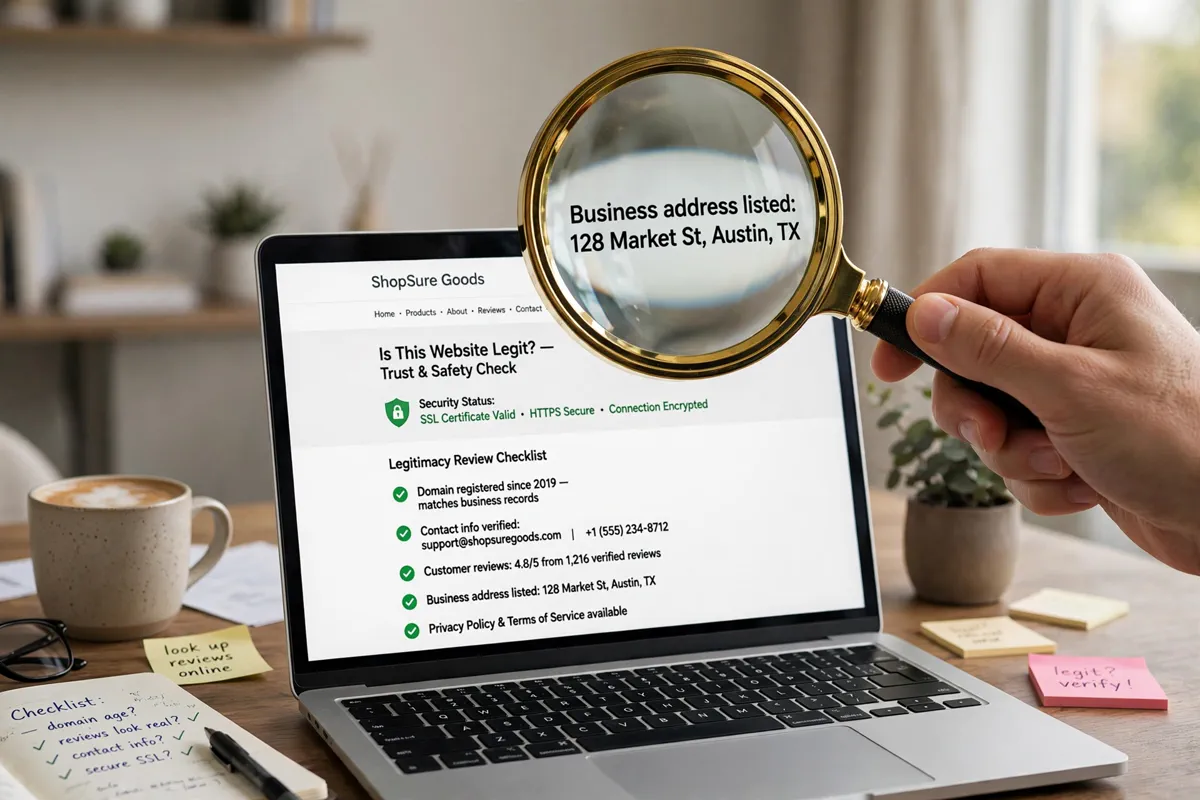
Before trusting any content site, it pays to check what it actually is, who runs it, and what it asks of you.
How to evaluate it yourself — and this applies to any site in this niche, not just this one:
- Read three articles, not one. A single good article proves nothing; consistent quality across several does. Look for clear explanations, correct examples, and writing that sounds like a person rather than spun text.
- Check the About page. Does it say anything concrete about who is behind the site? Vague mission statements are fine, but specifics build trust.
- Watch what it asks of you. A legitimate informational site lets you read without signing up or paying. If any page demands payment details, personal data, or software downloads to access “free” grammar content, treat that as a red flag and leave.
- Verify the URL. As covered above, similarly named domains offer different things. Make sure you are evaluating the site you think you are evaluating.
- Cross-check important claims. If an article makes a surprising claim about a grammar rule, verify it against an established reference before relying on it.
The bottom line: GrammarVista.com appears to be a legitimate informational website — a content site about English, not a scam, not a tool, and not a store. The honest limitations are that its ownership is not publicly clear and its publishing has expanded beyond grammar into general topics, so you should evaluate individual articles on quality rather than trusting the brand name blindly. Used as a supplementary reference alongside more established sources, it is a reasonable bookmark. Used as your sole authority for high-stakes writing, it is not enough — but then, no single free content site is.
Conclusion
GrammarVista.com is best understood as an informational content site about the English language — grammar guides, vocabulary resources, punctuation explanations, and writing tips, with a noticeable emphasis on American English usage. It is not a grammar-checking tool (that is the similarly named Grammervista.com), and its homepage has broadened beyond language topics into general-interest content, so each article deserves to be judged on its own.
Is it legit? By every publicly visible measure, yes: it reads as a normal content site with no signs of the behaviors that mark scam websites. The caveats are real but manageable — anonymous ownership and uneven topical focus mean you should use it as a helpful supplement, cross-check anything important, and always confirm you are on the right domain. Do that, and GrammarVista.com can earn its place in your bookmarks as a quick, readable reference for the everyday questions of written English.
Frequently Asked Questions
Is GrammarVista.com a grammar checker?
No. GrammarVista.com is an informational website publishing articles and guides about English grammar, vocabulary, and writing. It does not offer an interactive tool where you paste text for correction. The similarly named Grammervista.com (spelled with one “m”) is a separate website that does offer browser-based grammar-checking tools.
Is GrammarVista.com free to use?
Nothing in publicly available descriptions of the site suggests a paid product or paywalled content — it is described as an informational resource you read. That said, I have not audited every page, so the safe rule stands: if any page on any site asks for payment details to access supposedly free content, stop and investigate before proceeding.
Who owns GrammarVista.com?
I could not verify the owner, founding date, or editorial team from publicly available information. The site does not appear to publish a detailed masthead. This is common for small content sites but worth knowing when deciding how much weight to give its content.
What is the difference between GrammarVista.com and Grammervista.com?
They are different websites with confusingly similar names. GrammarVista.com (double “m”) is a content site with grammar articles and guides. Grammervista.com (single “m”) is a browser-based grammar-checking tool with features like spelling, clarity, and readability checks. Always check the exact URL before assuming which one you are on.
Is GrammarVista.com good for beginners?
It can be, if you start with fundamental topics like nouns, verbs, basic punctuation, and sentence structure before moving to advanced questions. Beginners may find some articles assume background knowledge, so use the site’s basic guides first and build up gradually.
Can I trust GrammarVista.com for academic or professional writing?
Use it as a supplementary reference, not your sole authority. For high-stakes writing — applications, academic work, published content — verify important rules against a second, established source. That is standard practice for any free content site, not a specific criticism of this one.
Read Also: Dramalit.com: What It Is, What It Publishes, and Is It Legit? (2026 Guide)

Admin
Contributor at Daily Scope 67.
Related reading

HelpDeskMe.com: What It Is, What It Publishes, and Is It Legit? (2026 Guide)
HelpDeskMe.com sells itself as a smart ticketing platform for support teams. We review what it offers, who it's for, and the similarly named tools you shouldn't confuse it with.
Read story
Quikconsole.com: What It Is, What It Publishes, and Is It Legit? (2026 Guide)
Quikconsole.com is a general-interest blog publishing short explainers on finance, tech, health, lifestyle and travel — not the AI dashboard many reviews claim. Here's what it really is and whether it's worth your time.
Read story
Test.com Pricing & Enterprise Plans: What It Offers & Is It Legit? (2026 Guide)
Test.com's current pricing and enterprise plans aren't publicly documented. Here's what the online test-maker actually is, what pricing was historically, how to get a quote, and the best alternatives with published prices.
Read story