
In this article
I still remember my first time on a snowboard. It was a freezing Saturday morning at Mammoth Mountain, and I was absolutely terrified. I kept thinking about all the ways I could wipe out in front of everyone. My friend Mike kept telling me it wasn’t that hard, but watching him cruise down the slope made it look impossible. Five minutes into my first attempt, I was sitting in the snow with my pants soaked through and my ego bruised. But here’s the thing, by the end of that day, I was actually having fun. By the end of that season, snowboarding had become my favorite winter activity. Today, I want to share everything I’ve learned with you because honestly, if I can do it, anyone can.
Snowboarding might seem intimidating at first. The learning curve is definitely steeper than skiing in those initial hours, but what makes snowboarding special is that once something clicks, it really clicks. You go from feeling completely helpless to actually carving down a mountain, and that feeling is absolutely incredible. In this guide, I’m going to walk you through every single step you need to take to go from never having stood on a snowboard to actually enjoying yourself on the slopes.
Understanding the Basics of Snowboarding
Before we jump into the technical stuff, let’s talk about what snowboarding actually is and why it’s become so popular. Snowboarding is essentially surfing on snow. You stand sideways on a board with both feet attached to it, and you navigate down a snowy mountain. Unlike skiing where you face downhill with two separate skis, snowboarding requires you to face sideways and use your whole body to control direction and speed.
The reason I’m mentioning this is because your mindset going in matters. If you’ve never surfed or skateboarded before, snowboarding will feel weird at first. Your brain and body aren’t used to moving this way. That’s completely normal. Every single person who’s ever snowboarded felt this same way. The difference between people who quit and people who keep going isn’t usually talent, it’s persistence and understanding that feeling awkward is part of the process.
Snowboarding has this beautiful progression where you start completely frustrated and confused, then something clicks and suddenly you understand how your body needs to move. This usually happens within your first or second day on the mountain. Most beginners feel significant improvement within two to three full days of riding. That’s actually faster than many sports, so keep that in mind when things feel frustrating.
Getting the Right Equipment
This is where a lot of beginners make mistakes. They either spend way too much money on equipment they don’t need, or they cheap out and end up with gear that makes learning harder. Let me break this down into the essential pieces.
The Snowboard Itself
Your first snowboard doesn’t need to be top of the line. In fact, I’d recommend against spending over three hundred dollars on your first board. You want a beginner-friendly board that’s forgiving and helps you learn instead of fighting against you. Look for boards specifically marketed as beginner boards. They tend to have softer flex, meaning they bend more easily, which helps you learn control. The length matters too. Your board should come roughly to your nose or chin when standing it upright next to you. A lot of beginners make the mistake of getting a board that’s too long, which makes turning much harder.
Boots and Bindings
This is critical and honestly overlooked by many beginners. Your boots need to fit properly. I mean really fit. Loose boots make it incredibly hard to control your board and will actually slow down your learning significantly. When you’re trying on boots, they should feel snug but not painfully tight. Your heel should be locked in place, and your toes should have just a tiny bit of room. Bindings are what attach your boots to your board. Make sure whatever boots you get are compatible with the bindings on your board. Most modern boots and bindings work together fine, but it’s worth double-checking.
Protective Gear
Here’s where I’m going to be real with you. You’re going to fall. Every single person learning to snowboard falls repeatedly. There’s no way around it. That’s why protective gear isn’t optional. At minimum, invest in wrist guards, knee pads, and a helmet. Your wrists will thank you. I know so many people who skipped wrist guards and broke their wrist trying to catch themselves in a fall. Helmets aren’t just for safety reasons either. They make you feel more confident, which actually helps you progress faster because you’re not nervous about hitting your head. Wear them.
Clothing
You need to dress warmly and stay dry. This means waterproof jacket and snow pants, warm base layers, and good gloves. Seriously, good gloves make such a difference. Wet hands make everything miserable. I spent my first season with cheap gloves that soaked through by mid-morning, and it made the whole experience less enjoyable. Invest in quality gloves and a good jacket, then you can spend less on other things.
Mastering Your Stance
Your stance is the foundation for everything that comes next. Get this right, and everything becomes easier. Get this wrong, and you’ll be fighting your board the whole time.
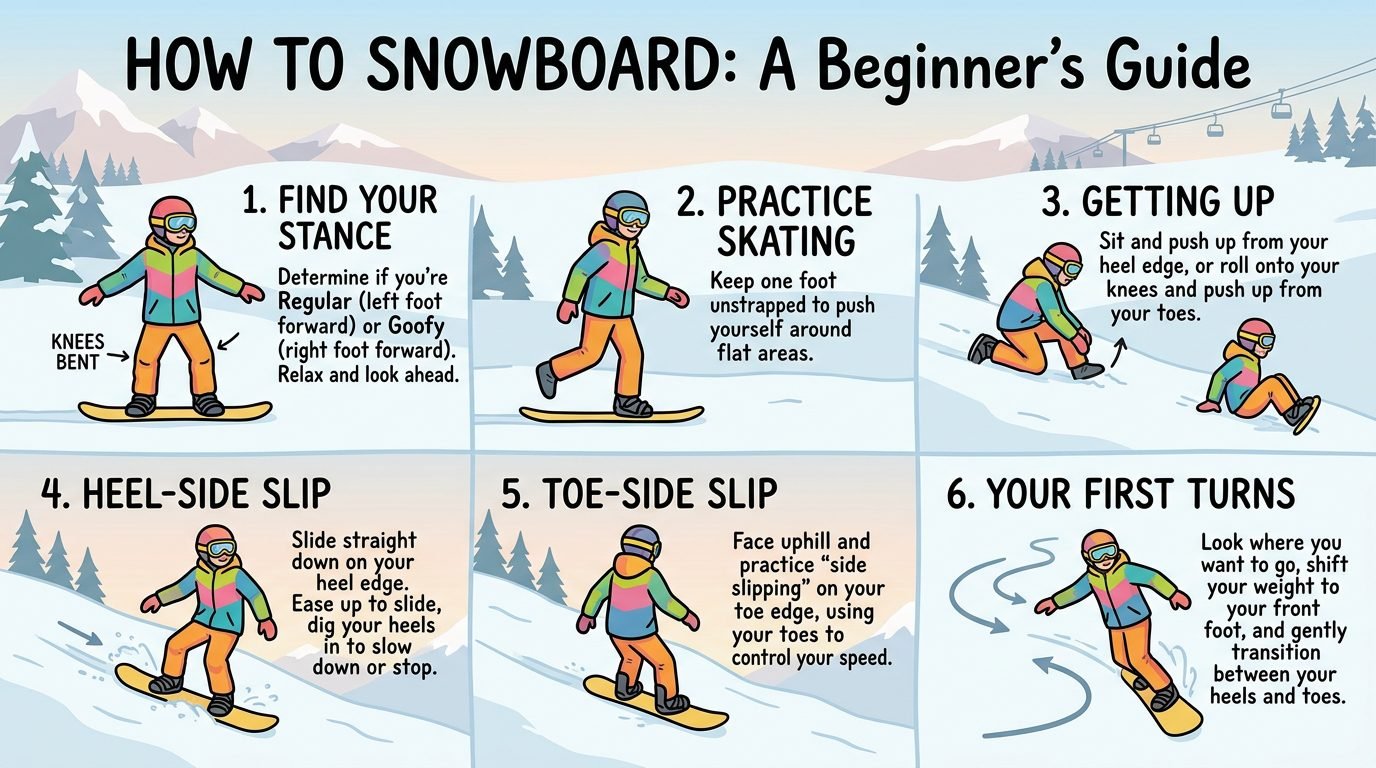
There are two main stances in snowboarding: regular and goofy. Regular stance means your left foot is forward, like you’re riding a skateboard normally. Goofy stance means your right foot is forward. You can usually figure out which one is natural for you by trying to slide across a slippery floor. Whichever foot you naturally put forward is probably your stance. That said, some people switch their stance over time, and that’s totally fine.
Once you know your stance, it’s time to get comfortable standing on your board. When you strap in both feet for the first time, your knees should be slightly bent, your weight should be centered, and your shoulders should be roughly parallel to your feet. A lot of beginners make the mistake of leaning back on their heels or getting their shoulders twisted. Your upper body should stay relatively quiet. Most of your movement comes from your lower body, not from waving your arms around.
The reason your knees need to be bent is because bent knees give you flexibility and control. When your legs are straight, you’re rigid and any bump in the snow will throw you off balance. Bent knees act like shock absorbers, helping you maintain control even when the terrain gets rough. Think about how a basketball player stays ready to move. Their knees are bent. It’s the same concept.
Learning to Balance
Balance is something that feels impossible for about ten minutes and then becomes second nature. The key to building balance is starting in the right environment. You shouldn’t try to learn balance on a steep run. You need a flat area or a very gentle slope. This is where lessons actually have value. A good instructor will put you in the right place and teach you the fundamentals instead of throwing you down the mountain.
The progression usually goes like this. First, you’ll learn to stand on the board on flat ground with both feet strapped in. This sounds simple but feels weird. Your instinct will be to tense up, but you need to relax. Try standing on one foot for a few seconds at a time, then switch. Practice shifting your weight from your toes to your heels. This is called edging and it’s fundamental to everything you’ll do.
Once you’re comfortable standing, it’s time to practice sliding. On a very gentle slope, you’ll start moving, and your job is just to stay on the board without falling off the sides. Your weight distribution matters here. You need to be centered, not too far forward or back. If you lean too far back, you’ll catch your heel edge and fall. If you lean too far forward, you’ll catch your toe edge and also fall. Finding that sweet spot takes time, but once you do, balance becomes much easier.
The Art of Turning
Turning is where snowboarding stops feeling random and starts feeling like you’re actually controlling something. This is also where the sport becomes fun instead of just frustrating.
There are two basic turns: heel edge turns and toe edge turns. If you’re regular stance, your toe edge is toward the front of your body and your heel edge is toward the back. To turn toward your toe edge, you put pressure on your toes and lean in that direction slightly. To turn toward your heel edge, you do the opposite.
When I first started, I tried to use my arms to turn, which made everything worse. Turns come from your legs and your core, not your arms. Your arms should stay relatively still. Think about what your legs are doing. To make a toe edge turn, you want to apply pressure to your toes by slightly flexing your ankle and knee. This isn’t a huge movement. Small, subtle weight shifts are much more effective than big dramatic movements.
The reason I’m emphasizing this is because watching other people ride and reading about snowboarding makes turns look more complicated than they actually are. Turns are really just about weight distribution and edge control. Once you understand that your board goes where your weight goes, everything becomes clearer. If you put weight on your toe edge, your board will turn that direction. If you put weight on your heel edge, your board will turn the other way. That’s it.
One thing that helped me understand turning was thinking about the board like it’s a steering wheel. You don’t jerk the steering wheel hard to change directions slightly. You make small adjustments. Same with snowboarding. Small, progressive weight shifts work better than sudden movements.
Stopping Safely and Speed Control
This might be the most important technique you learn as a beginner because you need to stop to be safe. Fortunately, stopping on a snowboard is actually pretty straightforward once you understand it.
The basic stop is called a heel edge stop. You turn your shoulders and hips to face uphill, lean back slightly on your heels, and your board will dig into the snow and slow you down. It feels backwards at first because you’re going downhill but turning uphill. But this is exactly how you control speed and stop.
The progression goes like this. Start on a gentle slope and practice turning your upper body uphill while letting your board follow. The more you face uphill, the more you’ll slow down. When you need to stop completely, face as much uphill as you can while leaning on your heel edge.
I want to be really honest here. Your first few stops will be dramatic. You’ll probably stop by falling. That’s fine. That’s actually how everyone learns. As you practice, you’ll figure out exactly how much edge pressure and uphill rotation you need to stop smoothly without falling.
Something that helped me was practicing speed control before practicing full stops. On a very gentle slope, practice controlling your speed by adjusting your edge angle. Steep angle equals slow. Shallow angle equals faster. By learning to feel this relationship between your board angle and your speed, stopping becomes much more intuitive.
Common Beginner Mistakes to Avoid
I’ve made basically every beginner mistake possible, and I want to save you the frustration.
Getting a Board That’s Too Long
Beginner boards should be roughly chin height or slightly shorter. Too long and you can’t rotate the board effectively. I used to think a longer board would be more stable, but I was wrong. Shorter boards are actually more stable for beginners.
Leaning Back
This is probably the number one mistake I see. People lean way back on their heels thinking it’ll help them control speed. It actually does the opposite. Leaning back makes your board twitchy and difficult to control. Stay centered. When you feel scared, your instinct is to lean back. Fight this instinct.
Going Too Fast Too Soon
You don’t have to attack every slope like you’re in the Olympics. Cruise at a speed you feel comfortable with. Speed will come naturally as your skills improve. Going too fast before you have the skills to handle it just means more falling and more frustration.
Skipping the Lessons
Look, I get it. Lessons cost money and feel like you should just be able to figure it out. But professional instructors can fix problems in minutes that would take you days to figure out on your own. It’s worth the investment, at least for one or two lessons to get the basics right.
Bad Footwear
Your boots are the connection between your legs and your board. Bad boots make everything harder. Don’t skip this. Get boots that fit properly from a shop where staff actually know what they’re doing.
Building Your Confidence and Mental Game
Snowboarding has a psychological component that people don’t talk about much. The first time you drop into a run and realize you’re moving downhill on a board, it’s scary. That fear is normal. The question is whether you let that fear stop you or whether you lean into it.
I had a moment about halfway through my first day where I just sat down in the snow and felt defeated. I was frustrated, I was cold, and I was tired. But something my instructor said stuck with me. She told me that the only difference between people who quit and people who progress is that people who progress have fallen more times. They’ve failed more, which means they’ve practiced more.
That shift in perspective changed everything. Instead of seeing falls as failures, I started seeing them as learning. By the end of the day, I’d fallen maybe thirty times. But I’d also learned something with each fall. By the end of the season, those falls meant nothing to me because I’d fallen thousands of times and lived to tell the tale.
Building confidence is really about accumulated experience. Each run gives you more information about how your body needs to move. Each fall teaches you that falling isn’t a catastrophe. You get up, dust yourself off, and keep going. That’s not just snowboarding advice. That applies to life too, honestly.
Realistic Progression Timeline
Let me give you realistic expectations so you’re not discouraged when things don’t happen overnight.
Day One
You’ll spend most of your first day feeling confused and frustrated. You might make it down a tiny hill without falling. Maybe not. You’ll definitely fall. A lot. By the end of the day, your legs will be exhausted, you’ll probably have some bruises, and you’ll question whether you want to do this again. This is completely normal.
Days Two and Three
Something starts to click. You realize how to control your edge. You make it down longer distances without falling. You still fall, but you’re falling less. You start to actually have fun moments between the frustrating moments.
First Week
By the end of your first week on the mountain, you can probably make it down a green run without falling too much. You can turn and stop with reasonable consistency. You’re still far from smooth, but you understand the basic mechanics.
First Month
After a month of regular snowboarding, you can handle most green runs comfortably. You can handle some blue runs depending on your fitness level and courage. You’re starting to look like you actually know what you’re doing, though you still have a long way to go.
First Season
After a full season, you can confidently ride most of the mountain. You’re working on style, smoothness, and maybe exploring terrain parks or backcountry depending on your interests.
The thing about snowboarding is that improvement isn’t linear. You’ll have days where you feel like you went backward. That happens to everyone. But over time, the trajectory is clearly upward if you keep practicing.
Safety Considerations and Injury Prevention
I want to circle back to safety because it’s genuinely important and easy to overlook when you’re excited about learning.
Wearing a helmet isn’t just about head protection. Helmets reduce wind noise, which helps you hear what’s going on around you. They make you look cool, which might sound silly but confidence matters. And yes, they protect your head. Do not snowboard without one. Full stop.
Wrist guards are non-negotiable for beginners. Your instinct when falling is to throw out your hands to catch yourself. That catches your wrists instead. Wrist guards prevent the majority of beginner injuries.
Knee pads matter less on groomed runs but are definitely worth wearing if you plan to explore anything steeper or more challenging.
Dress warmly and stay hydrated. Hypothermia and dehydration sneak up on you. Bring water, take breaks when you get cold, and know when to call it a day.
Finally, know your limits and don’t feel pressured to go down runs you’re not ready for. There’s no shame in skiing or snowboarding a slope multiple times. There is shame in ignoring warning signs about avalanche risk or visibility, so pay attention to trail conditions and weather.
Conclusion
Learning to snowboard has been one of the most rewarding things I’ve done. It’s not just a winter activity for me anymore, it’s become a huge part of my life and how I spend my winters. That first terrible day at Mammoth Mountain feels like a different lifetime now.
The truth is that anyone can learn to snowboard. It doesn’t matter if you’re athletically gifted or if you’ve never done anything like this before. What matters is that you show up, you practice, you accept that falling is part of learning, and you don’t give up when things feel hard.
My advice to anyone thinking about learning is to just do it. Take a lesson or two, rent decent equipment, find a beginner-friendly mountain, and start. You’ll fall. You’ll get frustrated. You’ll probably question your life choices a few times. But you’ll also experience moments of pure joy when you make a perfect turn or successfully navigate down a run you weren’t sure about before. Those moments are worth everything.
Snowboarding teaches you about yourself. It teaches you how you handle fear, frustration, and perseverance. These are lessons that apply far beyond the mountain. Every time you progress in snowboarding, you’re proving to yourself that you can do hard things. That’s a pretty powerful mindset to develop.
So if you’re thinking about learning to snowboard, stop thinking and start doing. Your future self will thank you.
Frequently Asked Questions
How long does it really take to learn snowboarding?
Most people can perform basic turns and make it down beginner slopes within three to five days of actual riding time. Becoming proficient takes a season or two. Becoming truly skilled takes years. But you can definitely have fun and enjoy yourself much sooner than you might think.
Is snowboarding harder than skiing?
The first few days of snowboarding are typically harder than skiing because your brain and body have to learn a completely new movement pattern. But after that initial adjustment, learning curves are pretty similar. Snowboarding generally has a steeper learning curve at the beginning and then a more forgiving progression afterward.
What’s the youngest or oldest age to start snowboarding?
I’ve seen kids as young as three on snowboards and adults starting in their sixties. Age is really not a limiting factor. Your fitness level and willingness to learn matter more than your age. That said, older beginners might want to invest more in protection and take lessons from instructors who specialize in teaching adults.
Do I need to buy equipment or can I rent?
Definitely rent while you’re learning. Buying gear is expensive and you don’t know what setup works for you yet. Rent for at least your first season. Once you’re sure you want to continue, then invest in your own equipment.
How much should I spend on equipment?
For complete beginner gear, budget around eight hundred to twelve hundred dollars for decent quality used or entry-level new equipment. You can spend less, but really cheap gear is often not worth it because it makes learning harder. Rentals run about thirty to fifty dollars per day.
Will I definitely get injured?
Not necessarily, but you’ll probably fall. Falls at low speeds on beginner terrain usually result in bruises and maybe some temporary soreness. Serious injuries are rare, especially when you’re on beginner terrain, wearing protection, and within your skill level. The biggest risk factor is doing things beyond your ability level.
What should I do if I’m scared?
Fear is healthy. Use it as information, not as a reason to quit. Start on easier terrain, take lessons, and build skills progressively. Your confidence will grow with experience. Everyone is scared at first.
Can I teach myself or do I need lessons?
You can technically teach yourself, but lessons are incredibly valuable. A good instructor can fix problems quickly and give you confidence that you’re on the right track. At minimum, a lesson or two early on is worth it.
What’s the difference between freestyle and all-mountain snowboarding?
Freestyle involves terrain parks with jumps and rails. All-mountain is just riding down the mountain focusing on carving and control. Start with all-mountain. Once you’re comfortable there, you can explore freestyle if you want.
How do I know if I have regular or goofy stance?
Slide on a slippery floor or try skateboarding. Whichever foot you naturally put forward is your stance. About eighty-five percent of people are regular stance, fifteen percent are goofy. Neither is better.

Admin
Contributor at Daily Scope 67.
Related reading
Complete Guide to Violin Lessons: Everything Beginners Need to Know
I still remember the first time I walked into a music studio to start my violin journey. My hands were shaking, and I had absolutely no…
Read story