
In this article
I still remember the first time I walked into a music studio to start my violin journey. My hands were shaking, and I had absolutely no idea what I was getting into. The violin sitting on the music stand looked intimidating, almost fragile. I wondered if I was too old to start, whether I had any talent, and if I would sound like a cat being stepped on during my first attempts. Twenty years later, I am so grateful I took that first step. Today, I want to share everything I have learned about violin lessons so you can start your own musical journey with confidence.
Understanding What Violin Lessons Really Are
Violin lessons are structured sessions where a qualified instructor teaches you how to play the violin. They are not just about learning the mechanics of holding the bow or placing your fingers on the strings. Real violin lessons encompass music theory, proper technique, reading sheet music, developing ear training, and building the discipline required to practice consistently. When you enroll in violin lessons, you are signing up for a comprehensive musical education that transforms not just how you play music, but how you think about it.
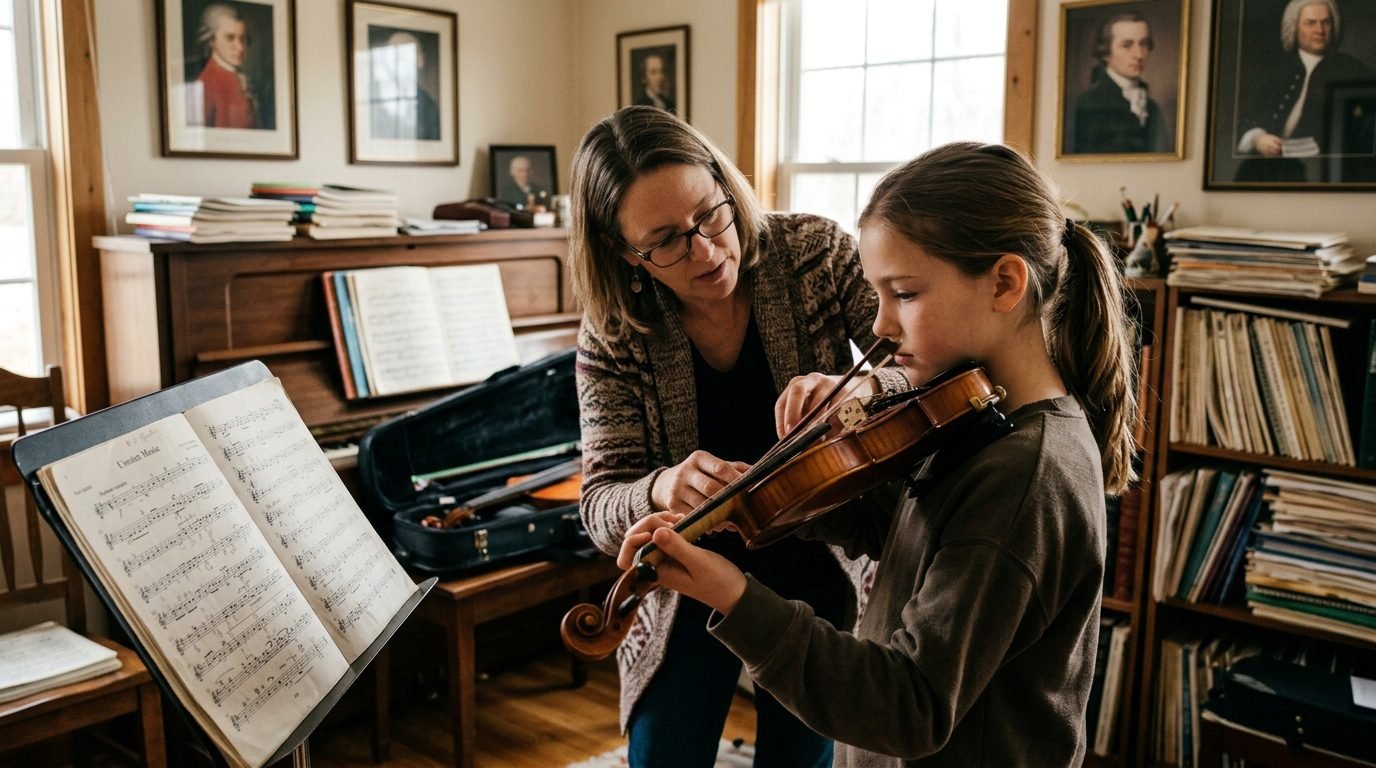
From my own experience, I discovered that violin lessons serve multiple purposes. They provide structured learning that keeps you accountable. Without lessons, most beginners get stuck around the three-month mark because they do not know how to progress beyond the basics. A good teacher gives you a roadmap. They know what you need to work on and create exercises specifically designed to address your weaknesses. They also provide immediate feedback, catching bad habits before they become ingrained in your muscle memory. I remember my first teacher stopping me mid-bow stroke to correct my wrist position. That small correction prevented what could have become a lifelong technical problem.
Types of Violin Lesson Formats Available Today
There are several ways to receive violin instruction, and each format has distinct advantages and disadvantages. Understanding these options helps you choose what works best for your lifestyle and learning style.
Private in-person lessons have been the gold standard for generations, and for good reason. When you sit in a music studio with a teacher who can see exactly how you are holding your instrument, how your bow moves, and how your fingers land on the strings, immediate corrections are possible. The teacher can physically demonstrate proper technique by playing passages for you. They can also adjust the temperature of the room, ensure the lighting is good for reading sheet music, and provide an environment free from distractions. I took private lessons for my first five years, and the personalized attention was invaluable. However, private lessons typically cost between thirty to eighty dollars per hour, depending on your teacher’s experience level and your geographic location.
Online violin lessons have exploded in popularity over the past five years, and they have become surprisingly effective. Video quality has improved tremendously, and many teachers can now see your hand position clearly enough to provide quality feedback. The major advantage of online lessons is convenience and flexibility. You take lessons from home, avoid commute time, and can often find highly qualified teachers from anywhere in the world at lower price points than local private lessons. Some excellent online platforms connect you with vetted instructors. However, online lessons require a good internet connection, proper camera positioning, and a stable setup at home. Some advanced techniques involving complex bowing patterns are admittedly harder to perfect through a screen.
Group violin lessons bring students together to learn collectively. This format is often significantly cheaper than private lessons, sometimes costing just ten to twenty dollars per student. Group lessons create a community feel and allow students to learn from watching others and hearing peer feedback. However, individual attention is limited. If you struggle with something specific, the teacher might not have time to work through it extensively with you. I have had friends who enjoyed group lessons for the social aspect but eventually switched to private lessons when they wanted to progress faster.
Self-taught learning is also possible, especially with the abundance of YouTube tutorials and educational apps available today. Some extremely disciplined individuals have taught themselves violin through these resources. However, I would not recommend this path for most people. Without a knowledgeable instructor watching your technique, you risk developing bad habits that are difficult to break later. It is like trying to learn proper swimming form by watching videos. You might get in the water and move around, but without someone correcting your strokes, you will not develop efficient technique.
Violin Lessons for Different Age Groups
The approach to violin lessons differs significantly depending on age. Children’s violin lessons, typically for ages five through twelve, focus heavily on building fundamental skills and maintaining enthusiasm. Young students have the advantage of developing muscle memory and ear training at an age when their brains are wired for language and pattern recognition. A good children’s violin teacher uses games, stickers, and positive reinforcement to keep lessons fun. Teachers work with parents because practice at home is crucial. A typical children’s lesson might be thirty minutes rather than an hour, as younger students have shorter attention spans.
Teenage violin lessons often involve more serious commitment. Teenagers can understand musical theory at a deeper level and appreciate classical repertoire. Many teenagers use lessons to prepare for music school applications or to compete in competitions. The challenge with teenagers is keeping them engaged when they might prefer other activities. A skilled teacher balances challenging pieces with music they want to play, whether that is contemporary classical, folk music, or soundtrack pieces from their favorite movies.
Adult violin lessons are incredibly rewarding, and I want to spend time on this because I believe many adults think they are too old to start. The truth is that adults often make excellent students. We bring life experience, discipline, and the ability to understand complex concepts. Adult learners are motivated by personal choice rather than parental pressure. Many adults I know started violin lessons in their forties or fifties and made impressive progress. Yes, your fingers might be less flexible than a child’s, and yes, developing muscle memory takes a bit longer, but adult learners often progress faster through the beginner phase because we understand the value of consistent practice. My friend Robert started violin at age fifty-four and performed at a local concert just three years later.
Finding the Right Violin Teacher for Your Journey
Choosing a violin teacher is perhaps the most important decision you will make on your musical journey. A great teacher can inspire you and accelerate your progress. A poor teacher can frustrate you and make practice feel like a chore. When I was looking for my first teacher, I did not know what questions to ask. I wish I had followed this advice, which I am now passing on to you.
First, consider the teacher’s qualifications. Have they studied violin formally? Do they have performance experience? Many excellent teachers have musical degrees, though some self-taught teachers can also be effective. What matters most is that they can demonstrate what they teach and explain concepts clearly. I recommend asking about their training, experience level, and teaching philosophy before booking a lesson.
Second, take a trial lesson. Most professional teachers offer a trial lesson at a reduced rate or sometimes free. This gives you a chance to see if your learning styles are compatible. Do they explain things in ways you understand? Do they make you feel comfortable asking questions? Is the lesson structured and productive, or does it feel disorganized? Pay attention to how they correct you. Do they explain why something is wrong and how to fix it? Or do they just say “no, do it this way”? After my first trial lesson with my current teacher, I knew it was the right fit because she explained the reasoning behind techniques rather than just demanding compliance.
Third, consider logistics. Is the teacher located conveniently if you are doing in-person lessons? What is their cancellation policy? Are they reliable about starting and ending on time? These practical considerations affect your long-term success.
Fourth, think about the teacher’s specialization. Some teachers focus primarily on classical music, while others teach contemporary styles or folk traditions. If you want to play jazz or fiddle music eventually, find a teacher experienced with that style. If you are aiming for classical training, find someone with classical expertise.
What to Expect in Your Very First Violin Lesson
Your first lesson can feel nerve-wracking, but it is actually quite straightforward. Most first lessons are devoted to getting to know each other and assessing your starting point. The teacher will probably ask about your musical background, why you want to learn violin, and what you hope to achieve. They will explain what violin lessons involve and set expectations about practice.
The teacher will show you how to hold the violin. This is surprisingly important because holding it incorrectly leads to tension, pain, and technical problems later. You learn to position the violin under your chin, supported by your left shoulder. Your right hand holds the bow. The teacher will have you practice these positions repeatedly until they feel natural.
You will be introduced to basic music theory. Even absolute beginners need to understand how to read notes on the staff. Do not worry if this seems overwhelming. Most teachers introduce these concepts gradually over many lessons. You will learn about the treble clef, note names on the lines and spaces, and how to count rhythm.
You will probably make your first sounds on the violin. This is the moment most beginners worry about. Yes, it might sound scratchy. Yes, it might sound a bit like a cat. But honestly, I have never met a beginner who sounded terrible on their first attempt. Teachers expect new students to sound rough. The goal is just to produce sound and understand how to move the bow across the strings with basic control.
Finally, your teacher will assign practice work for the week. This is typically fifteen to thirty minutes daily for beginners. The teacher will explain what you should practice and why.
Understanding the Cost of Violin Lessons
Money is a practical consideration that affects many people’s decisions about whether to pursue violin lessons. Let me break down the typical costs you can expect.
Private in-person lessons with an experienced teacher generally range from thirty to eighty dollars per hour, with an average of fifty dollars. Very experienced teachers, especially those associated with universities or who perform professionally, might charge more. Less experienced teachers or music students offering lessons might charge less. Some teachers offer package discounts if you pay for multiple lessons upfront.
Online lessons typically cost slightly less, maybe twenty to sixty dollars per hour. The lower cost reflects reduced overhead for the teacher and access to a wider geographic student base, allowing teachers to charge less while still maintaining a healthy income.
Group lessons cost significantly less because the teacher’s fee is divided among multiple students. You might pay ten to thirty dollars per student for a group lesson.
Beyond lesson costs, you should budget for a violin. You can purchase a decent beginner violin for one hundred fifty to four hundred dollars. Do not buy the cheapest violin you find, as very cheap instruments are difficult to play and sound poor. Many teachers have recommendations for good beginner instruments. You might also need a bow, rosin, shoulder rest, and music stand, which add another fifty to one hundred dollars to your initial investment.
Practicing Between Lessons: The Real Work
Here is something I wish I understood when I started. The lesson is actually the smaller part of learning violin. Real progress happens during the practice days between lessons. Most teachers recommend practicing at least four to five days per week, ideally daily, for thirty minutes to an hour.
Effective practice is different from just playing through pieces repeatedly. A good practice session has a structure. Start with warm-up exercises that develop finger flexibility and bow control. Then work on any techniques your teacher specifically assigned. Next, practice pieces you are learning, focusing on difficult sections rather than playing through entire pieces. Finally, spend time on theory or ear training exercises if your teacher assigned them.
I have found that consistent practice, even just thirty minutes daily, produces better results than sporadic longer practice sessions. Your fingers need time to build muscle memory and endurance. Missing days means losing progress. However, do not get discouraged if you miss a few days. Just pick it back up and keep going.
Many beginners struggle with motivation during practice. Some strategies I have found helpful include practicing at the same time each day so it becomes routine, setting specific practice goals for each session, recording yourself to track improvement, and rewarding yourself when you master difficult passages.
Common Challenges Beginners Face
Almost every violin student faces similar challenges. Knowing what these are can help you prepare mentally and not feel discouraged when they happen to you.
Finger pain is very common in the first month. Your fingers are building calluses, and you are developing hand strength. This typically subsides after a few weeks. Using proper technique and not practicing too intensely all at once helps. If pain becomes severe, talk to your teacher.
Frustration with progress is real. The violin seems impossible when you first start. Suddenly around week six or eight, something clicks and you can actually play recognizable melodies. This breakthrough moment is so rewarding. Stick with it past the difficult early phase.
Bow control is challenging for most beginners. Producing a clear, consistent tone while moving the bow smoothly requires coordinating both hands in unfamiliar ways. This takes time to develop. Your teacher will give you specific exercises to build this skill.
Staying motivated is perhaps the biggest challenge. Learning violin is a long-term commitment. You will not sound like a professional for several years. You need to find joy in the process itself, celebrating small improvements and enjoying the music you are creating, even if it is simple.
The Remarkable Benefits of Learning Violin
One reason I am so passionate about violin is because of how learning this instrument has enriched my life. The benefits extend far beyond just being able to play music.
Cognitive development is well documented. Learning violin engages your brain in complex ways. You are reading music, coordinating both hands independently, listening to pitch and tone quality, and remembering technique all simultaneously. Research has shown that music students often perform better academically, particularly in mathematics and language skills.
Emotional expression becomes possible in new ways. Music allows you to express feelings that are difficult to put into words. I have found violin to be therapeutic, a way to process emotions and stress. Many students tell me they feel calmer and more centered after practicing.
Discipline and goal-setting develop naturally through violin study. You set small goals, like mastering a particular passage, and work toward them. You learn that consistent effort produces results. This mindset translates to other areas of your life.
Social connection and community happen when you make friends through group lessons or playing with others. Music brings people together in meaningful ways. As you progress, you might join orchestras, chamber groups, or jam sessions with other musicians.
Cultural appreciation deepens as you explore classical music and learn about composers from different eras and countries. You begin to understand the rich history of violin music across cultures.
How Long Does It Actually Take to Learn Violin
This question is asked constantly by potential students, and the answer depends on what you mean by “learning” violin. If you mean being able to play simple recognizable melodies, that can happen within two to three months of consistent practice. If you mean developing intermediate proficiency where you can play a wide variety of pieces with good tone and technique, expect one to two years. To reach advanced levels where you can play challenging classical concertos, count on five to ten years or more of dedicated study.
Progress is not linear. Some weeks you will feel like you are improving rapidly. Other weeks you will feel stuck. Plateaus are normal and do not mean you are not making progress. Often you are consolidating skills and your next breakthrough is just around the corner.
Conclusion
Starting violin lessons is one of the best decisions you can make for personal growth and musical enrichment. Whether you are considering lessons for yourself or your child, understand that violin learning is a journey, not a destination. Yes, it requires investment in time and money. Yes, it can be frustrating at times. But the rewards are substantial. You gain a new way to express yourself, develop discipline and focus, join a community of musicians, and create something beautiful.
Do not let fear of being a beginner stop you. Every accomplished musician started exactly where you are now, with no idea how to hold the instrument and uncertain if they had talent. The talent develops through consistent practice and good instruction. Find a teacher who inspires you, commit to regular practice, and allow yourself to enjoy the learning process.
I often tell people who express interest in violin that the best time to start was probably years ago, but the second best time is today. Your age does not matter. Your starting point does not matter. What matters is that you are willing to learn and grow. That is when the magic of music can enter your life.
Frequently Asked Questions
Q1: Am I too old to start learning violin?
No, absolutely not. While younger learners sometimes develop faster muscle memory, adults often make excellent students. Many adults start in their forties, fifties, or even later and make remarkable progress. Adult learners typically have discipline, motivation, and the ability to understand complex concepts, which can actually help them progress through the beginner phase faster than children in some ways.
Q2: How much do I need to practice daily?
For beginners, practicing thirty to forty-five minutes daily, five to six days per week is ideal. As you progress, many students increase practice time to an hour or more. Consistent daily practice is more effective than occasional longer sessions because it helps build muscle memory and technique more efficiently.
Q3: What if I cannot afford private lessons?
Consider these alternatives. Group lessons are significantly cheaper and provide structured learning with other students. Some teachers offer discounted rates for committing to multiple lessons upfront. Online lessons are often less expensive than in-person private lessons. You might also look for community music programs or school programs that offer affordable instruction.
Q4: Can I teach myself violin using online resources?
While online tutorials and apps exist, teaching yourself is challenging without feedback from a qualified instructor. You risk developing bad technical habits that are difficult to break later. At minimum, an experienced teacher should evaluate your technique periodically, even if you do most learning independently.
Q5: What is the difference between a full-size and fractional-size violin?
Full-size violins are standard and suit most adults and children aged about twelve and up. Fractional sizes (three-quarter, half, one-quarter) are available for younger or smaller children. Your teacher can help determine the right size for your body frame.
Q6: Do I need to read music to learn violin?
Yes, you will need to learn to read music. However, this is taught as part of your violin lessons. Most teachers introduce note reading gradually, starting with just a few notes. By your second or third month, you should be reading basic melodies.
Q7: Is violin harder than other instruments?
Violin has a steeper initial learning curve than some instruments because the strings require precise finger placement to produce in-tune notes, and bow control is initially very challenging. However, with proper instruction and consistent practice, beginners can progress past the difficult early phase within a few months.
Q8: What type of violin should a beginner buy?
Invest in a decent beginner instrument priced between one hundred fifty and four hundred dollars. Avoid very cheap instruments as they are difficult to play and discouraging. Ask your teacher for specific recommendations. Many teachers have relationships with music shops and can guide you toward good values.
Q9: Can I play modern music like pop or folk on violin?
Absolutely. While much violin training focuses on classical music, violin is incredibly versatile. You can play folk music, pop songs arranged for violin, jazz, and contemporary music. Talk with your teacher about your musical interests so they can incorporate repertoire that keeps you motivated.
Q10: How often should I take lessons?
For most students, once per week is ideal. This allows enough time between lessons to practice and consolidate what you learned, while maintaining momentum. Some advanced students might take lessons less frequently as they become more independent learners, while absolute beginners sometimes benefit from more frequent lessons.

Admin
Contributor at Daily Scope 67.
Related reading
How to Snowboard: Complete Beginner’s Guide to Learning and Progressing on the Mountain
I still remember my first time on a snowboard. It was a freezing Saturday morning at Mammoth Mountain, and I was absolutely terrified. I kept thinking…
Read story