

In this article
- Who Is James Comer?
- Early Life and Education
- Farming and Business Career
- Kentucky House of Representatives (2001–2012)
- Kentucky Commissioner of Agriculture (2012–2016)
- Serving in the U.S. House of Representatives
- Chairing the Oversight Committee
- What Does James Comer Do Now?
- Personal Life and Public Image
- Common Misconceptions About James Comer
- Frequently Asked Questions
- Conclusion
If you follow American politics even casually, the name James Comer has probably crossed your screen — usually attached to a congressional hearing, a committee announcement, or a headline about government oversight. But who is he, actually? Beyond the soundbites, what’s his story?
This is a straightforward, neutral biography built only on publicly verifiable facts: his Kentucky roots, his farming background, his climb through state politics, and his current role in Washington. No speculation, no invented details — just the documented record of how a farmer from Monroe County became one of the most visible members of Congress.
Who Is James Comer?
James Richardson Comer Jr. (pronounced “KOH-mər”) is an American politician serving as the U.S. Representative for Kentucky’s 1st congressional district. A member of the Republican Party, he has held the seat since November 2016. Since 2023, he has served as chairman of the House Committee on Oversight — one of the most powerful and high-profile committee assignments in Congress.
Before Washington, Comer’s career ran entirely through Kentucky: six terms in the Kentucky House of Representatives, followed by a term as the state’s Commissioner of Agriculture. His background is in farming and business, not law or political consulting, which sets him apart from many of his congressional colleagues.
His district — Kentucky’s 1st — covers 35 counties stretching from the Mississippi River in the west to Central Kentucky, including the cities of Paducah and Frankfort. It’s a heavily rural district, and agriculture has been the through-line of both his personal life and his political identity.
Early Life and Education
James Comer was born on August 19, 1972, in Carthage, Tennessee. He grew up in Monroe County, Kentucky, a rural county in the state’s south-central region near the Tennessee border. His father, Dr. James R. Comer Sr., was a dentist, and his mother was Sandra Witcher Comer.
He graduated from Monroe County High School in Tompkinsville, Kentucky, in 1990, then attended Western Kentucky University in Bowling Green, where he earned a Bachelor of Science degree in Agriculture in 1993. During his college years, he served as president of the Kentucky Future Farmers of America — an early sign of where his interests lay.
That agricultural education wasn’t just a credential; it became the foundation of his working life. Unlike many politicians who pivot into politics from law or finance, Comer went straight into the business he had studied.
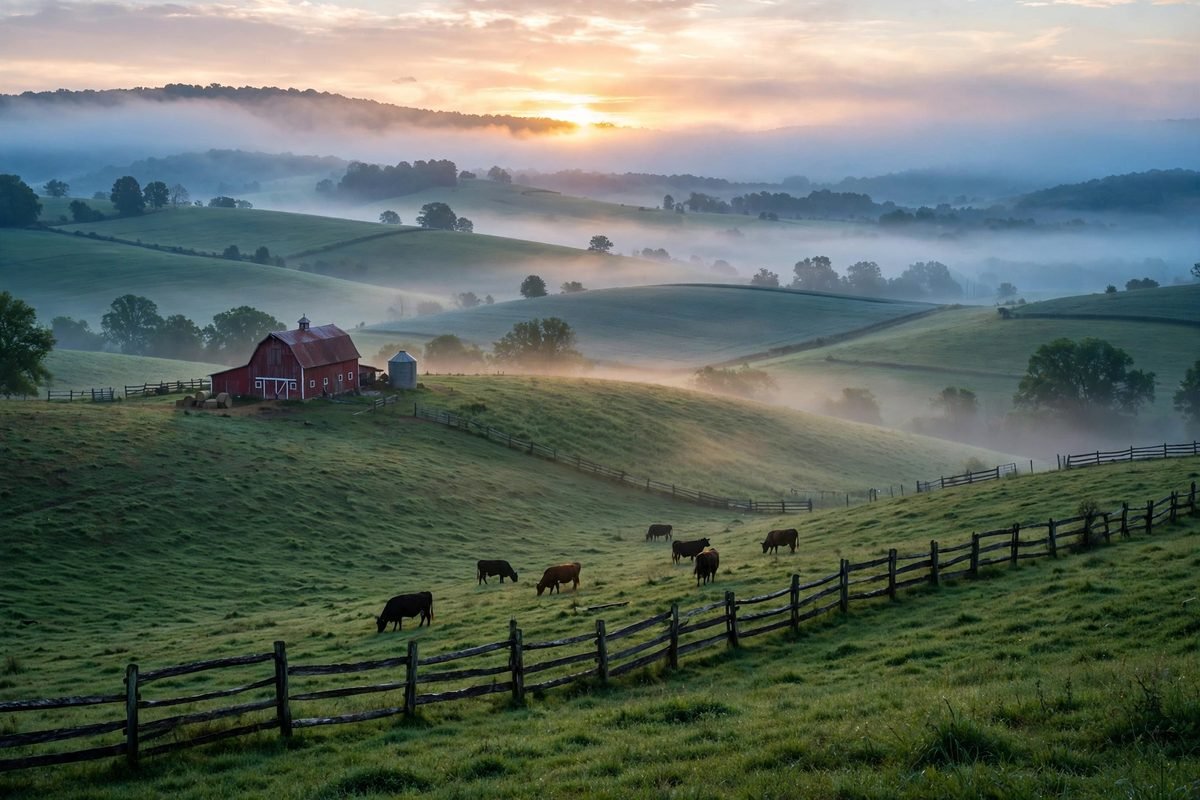
Kentucky farmland shaped Comer’s life and politics long before he reached Washington.
Farming and Business Career
After college, Comer went into farming and agribusiness in Monroe County. He started James Comer, Jr. Farms — a farming operation reported at around 2,300 acres — and co-owns Comer Land & Cattle Co. He has described himself throughout his career as a farmer and businessman first, and that identity has remained central to his public image.
Beyond the farm gate, he was active in local civic and business life. He served as president of the Monroe County Chamber of Commerce from 1999 to 2000 and spent 12 years as a director of South Central Bank. He also chaired the Monroe County Republican Party from 1993 to 1995 and served as a delegate to the Republican National Convention in 1996.
This local grounding matters for understanding his politics. Comer’s career was built county by county in rural Kentucky, not in Washington think tanks or national campaign machinery. When he talks about regulations burdening farmers and small businesses, he’s speaking from direct experience — which is part of why the message resonates with his constituents.
Kentucky House of Representatives (2001–2012)
Comer entered elective office in 2000, winning a seat in the Kentucky House of Representatives representing District 53. He would serve six terms, remaining in the state House through 2012.
During his first term, he was named National Republican Freshman Legislator of the Year — an early indication that party leaders saw promise in the young farmer-legislator. Over his twelve years in Frankfort, he built a reputation as an effective state-level operator focused on agricultural and rural issues.
State legislatures are where most American politicians actually learn the craft: negotiating budgets, serving constituents, building coalitions vote by vote. Comer’s long apprenticeship in Frankfort gave him something many Washington newcomers lack — a deep, practical understanding of how government affects daily life at the ground level.
Kentucky Commissioner of Agriculture (2012–2016)
In 2011, Comer was elected Kentucky’s Commissioner of Agriculture, taking office in 2012. The role put him in charge of the Kentucky Department of Agriculture — the state agency overseeing everything from consumer protection to agricultural development.
He inherited an agency with documented problems. According to his official biography, he set out to address scandal within the department, restore public confidence, and crack down on waste, fraud, and abuse — including selling off unneeded equipment and returning money to the state treasury.
His signature achievement in the role was positioning Kentucky as a national leader in industrial hemp production. Comer championed the effort to legalise industrial hemp in Kentucky, a cause that later became part of his congressional identity as well — he served on the conference committee that negotiated the 2018 Farm Bill, which established a legal framework for the nation’s hemp industry.
The agriculture commissioner years did two things for Comer: they gave him statewide name recognition, and they gave him a record to run on. Both would prove essential for what came next.
Serving in the U.S. House of Representatives
In 2015, Comer sought the Republican nomination for governor of Kentucky but lost the primary — by a famously narrow margin of just 83 votes, according to political analysts. It was a bruising defeat, but it kept his name in statewide circulation.
The following year, opportunity arrived from an unexpected direction. U.S. Representative Ed Whitfield resigned from Kentucky’s 1st congressional district seat, and Comer won the Republican nomination to succeed him. On November 8, 2016, he won both a full term for the next Congress and a special election to serve the remainder of Whitfield’s term — meaning he took office immediately rather than waiting for January.
He has been re-elected to succeeding Congresses since, representing the district continuously from November 2016 to the present. In Congress, his work has centred on the issues of his background and his district: agriculture policy, rural broadband expansion, infrastructure funding for roads, bridges, ports, and water systems, and reducing regulatory burdens on farmers and small businesses. He helped negotiate and pass the 2018 Farm Bill and has advocated for biofuel policies such as year-round E15.
For broader coverage of American political news and current affairs, Daily Orvix publishes regular updates on U.S. politics and government developments.

Committee rooms like this one are where much of Congress’s real work — and real conflict — happens.
Chairing the Oversight Committee
In 2023, following the Republican takeover of the House, Comer became chairman of the House Committee on Oversight and Accountability (styled in the 119th Congress as the Committee on Oversight and Government Reform). This is one of the most powerful perches in Congress: the Oversight Committee has broad jurisdiction to investigate the executive branch and virtually any matter of federal concern.
As chairman, Comer has used the committee’s investigative powers aggressively — most notably launching high-profile investigations into President Joe Biden and his family’s business activities. These investigations have made him one of the most visible figures in Washington and a regular presence in national political coverage.
The role has also made him a polarising figure, as Oversight chairmanships tend to do. Supporters credit him with pursuing accountability; critics dispute the basis and conduct of his investigations. What’s not in dispute is the position itself: chairing Oversight puts a member at the centre of American political combat, and Comer has occupied that centre since 2023.
What Does James Comer Do Now?
As of 2026, Comer continues to serve as the U.S. Representative for Kentucky’s 1st District and as chairman of the House Oversight Committee. His stated priorities remain consistent with his record: agricultural policy, rural development, infrastructure investment in his district, and the committee’s oversight agenda.
Political analysts have also noted him as a potential candidate for governor of Kentucky in 2027 — a plausible next step given his statewide profile, his narrow 2015 primary loss, and the term-limited governorship. Whether he runs remains his decision to announce, but the speculation reflects how firmly he is established in Kentucky politics.
For readers interested in how American political figures shape policy debates, Home Water Insights covers U.S. current affairs and civic topics from an independent angle.

Kentucky’s 1st District stretches from the Mississippi River to Central Kentucky.
Personal Life and Public Image
Comer is married to Tamara Jo Comer, and the couple has three children. The family remains rooted in Monroe County, Kentucky, where his farming business is based — a detail he references often, presenting himself as a legislator who still lives the rural life he represents.
Publicly, Comer cultivates the image of a plain-spoken farmer-legislator: direct in interviews, fond of agricultural metaphors, and quick to frame Washington debates in terms of how they affect small towns and family farms. Supporters see authenticity in that style; critics argue it oversimplifies complex issues. Either way, the persona is consistent with the biography — it’s the same identity he carried through the Kentucky House and the agriculture commissioner’s office, scaled up to a national stage.
Common Misconceptions About James Comer
- “He’s a career Washington insider.” His career actually ran through Kentucky for over two decades before he reached Congress in 2016 — state House, agriculture commissioner, farming and local banking. Washington is the latest chapter, not the whole story.
- “He’s a lawyer.” No — his degree is in agriculture from Western Kentucky University, and his working background is farming and business.
- “Oversight chairman is a ceremonial title.” Far from it. The Oversight Committee’s subpoena power and broad jurisdiction make its chairman one of the most consequential figures in any Congress.
- “His district is a single city.” Kentucky’s 1st spans 35 counties — it’s a large, predominantly rural district, which explains why agriculture dominates his agenda.
Frequently Asked Questions
Who is James Comer?
James Comer is the U.S. Representative for Kentucky’s 1st congressional district (since 2016) and chairman of the House Committee on Oversight and Accountability (since 2023). He is a Republican with a background in farming and Kentucky state politics.
How old is James Comer?
He was born on August 19, 1972, in Carthage, Tennessee, which makes him 54 years old as of 2026.
What did James Comer do before Congress?
He served six terms in the Kentucky House of Representatives (2001–2012) and as Kentucky’s Commissioner of Agriculture (2012–2016). Before and alongside politics, he worked as a farmer and businessman in Monroe County, Kentucky.
What district does James Comer represent?
Kentucky’s 1st congressional district — 35 counties from the Mississippi River to Central Kentucky, including Paducah and Frankfort.
What is James Comer’s role on the Oversight Committee?
He has chaired the House Oversight Committee since 2023, giving him authority over the committee’s investigations into the executive branch and federal matters.
Is James Comer running for governor?
He has been discussed by political analysts as a likely candidate for Kentucky governor in 2027, but as of this writing he has not formally announced such a campaign. He previously sought the Republican gubernatorial nomination in 2015, losing the primary by 83 votes.
Conclusion
James Comer’s story is, at its core, a familiar American one: a kid from rural Kentucky who studied agriculture, built a farming business, served his county and state, and eventually carried those roots all the way to one of the most powerful committee chairs in Washington. Whether you admire his politics or not, the trajectory itself is a matter of public record — and understanding it is the first step to understanding why he does what he does in Congress.
As he continues to lead the Oversight Committee — and as speculation about a 2027 gubernatorial run builds — Comer is likely to remain a central figure in American political news. Now you know the background behind the headlines.
Read Also: Megalotto USA: Your Gateway to American Lottery Dreams from India

Admin
Contributor at Daily Scope 67.
Related reading

Marissa Munoz: The Rising Talent in Entertainment You Should Know About
When you think about talented individuals making waves in the entertainment industry, there are certainly a lot of names that come to mind. However, there’s one…
Read story
Christian Gartner: The Austrian Mountaineer Who Conquered the World’s Most Dangerous Peaks
When you think about extreme mountaineers who push the boundaries of human endurance, very few names come to mind with the same level of respect and…
Read story
3 comments