
In this article
In this article:
- What 192.168.0..107 Actually Means
- Why the Double Dot Breaks the Address
- The Two Addresses You Probably Meant
- What Is 192.168.0.107?
- What Is 192.168.0.1?
- How to Find Your Real Router and Device IP
- How to Log In to Your Router Admin Panel
- What to Do If the Login Page Still Will Not Load
- Common Router Login Mistakes to Avoid
- Keeping Your Home Network Safe After You Log In
- Frequently Asked Questions
- Conclusion
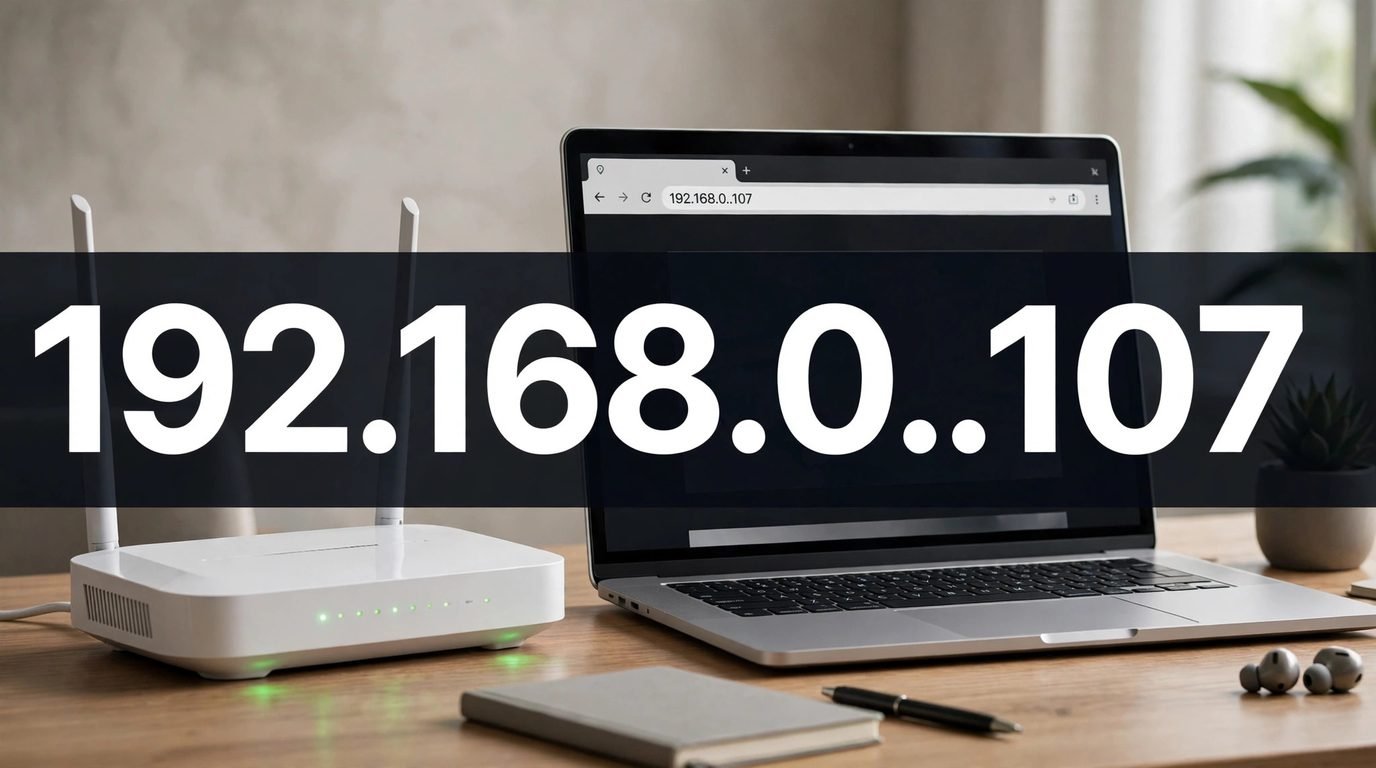
If you typed 192.168.0..107 into your browser and got an error page, a search results page, or a message saying the site cannot be reached, you are not alone.
192.168.0..107 shows up a lot in search boxes, and the reason is simple: it looks almost right. It has the familiar shape of a home network address, it starts with the numbers most people associate with a router, and it ends with a number that could easily belong to a phone, laptop, or smart TV on a home Wi-Fi network. The problem is the tiny detail in the middle. There are two dots in a row, and that one extra character is enough to make the whole address invalid.
That does not mean you did something foolish. It means you probably meant one of two very similar, perfectly valid addresses, and your browser could not guess which one you wanted, instead of 192.168.0..107.
This article sorts that out in plain language. You will learn why 192.168.0..107 cannot work, what 192.168.0.107 means when it is written correctly, what 192.168.0.1 means and why it matters even more, how to find the correct address for your own network on Windows, Mac, iPhone, and Android, and how to open your router’s admin panel once you have the right number. No technical background is needed. By the end, you will be able to tell the difference between a device address and a router address, and you will know exactly what to type next time.
What 192.168.0..107 Actually Means
Short answer: 192.168.0..107 means nothing, at least not as an internet address. An Internet Protocol address, usually shortened to IP address, is a set of numbers that identifies a device on a network. The version most home networks still use is called IPv4. An IPv4 address is made up of four groups of numbers, called octets, separated by single dots. A familiar example is 192.168.0.1. Count the groups: 192, then 168, then 0, then 1. Four groups, three dots, one dot between each pair of groups. That structure is not a style choice. It is the rule that lets routers, computers, and phones understand the address at all.
Now look again at 192.168.0..107. Count the groups and the dots. You get 192, 168, 0, then an empty space where a number should be, then 107. There are four dots instead of three, and one of the groups is empty. Your browser reads that empty group and stops. It cannot fill in the blank for you, because it has no way of knowing whether you meant to type an extra dot by accident, leave out a number, or combine two different addresses. So it treats 192.168.0..107 as invalid and either shows an error or hands it to a search engine, which is why you sometimes end up on a search results page instead of a login page.
This is worth stating clearly because it clears up the most common misunderstanding around 192.168.0..107. The double dot is not a special kind of address. It is not a hidden admin address, a secret backdoor, or a newer format. It is a typo, and a very understandable one. On
a phone keyboard, the dot key sits close to other keys, and when you are copying an address from a sticker, a manual, or a forum post, it is easy to tap it twice without noticing. The good news is that the fix is equally small: remove one dot from 192.168.0..107, and you are back to a real address. The only question is which real address you meant, and that depends on what you were trying to do.
Why the Double Dot Breaks the Address
To understand why one extra dot matters so much, it helps to know how a browser handles what you type into the address bar. When you type a normal website name, the browser asks a system called DNS to turn that name into an IP address. When you type numbers and dots, the browser first checks whether the string follows the rules for an IP address. If it does, it tries to connect directly to that address. If it does not, it assumes you typed a search term and sends it to your default search engine instead. That is why
a typo like 192.168.0..107 often feels confusing: you expected a router page, but you got search results, and nothing in the results explains what went wrong.
Each group in an IPv4 address must be a number from 0 to 255. That range is part of the definition, and it is why an address like 192.168.0.999 would also fail, even though its shape looks right. 192.168.0..107 fails earlier than that, because it does not even have four proper groups. Think of it like a phone number with a missing digit and an extra dash. A person reading it might guess what you meant, but an automated system that routes calls cannot guess. It needs the exact format. Browsers and routers are the same. They are precise by design, because guessing wrong on a network could send your login details to the wrong device.
There is one more detail that trips people up. Some browsers will quietly try to fix small mistakes in website names, but they do not rewrite IP addresses. That caution is actually a safety feature. If a browser changed 192.168.0..107 into 192.168.0.107 on its own, it might send you to a device you did not intend to reach. So the browser refuses, and you see the error. Once you know that, the error stops feeling like a broken router and starts feeling like what it really is: a helpful refusal to guess.
The Two Addresses You Probably Meant
Almost everyone who types 192.168.0..107 meant one of two addresses. Figuring out which one saves a lot of trial and error.
The first candidate is 192.168.0.107. This is the same string with one dot removed. It is a valid IPv4 address, and on many home networks it would belong to a single device, such as a laptop, phone, printer, or smart speaker that joined the Wi-Fi and was given that number by the router. If you were trying to reach a specific device on your network, for example to open a printer’s settings page or a media server, this is likely the address you had in mind.
The second candidate is 192.168.0.1. This is the address most people actually want when they are trying to “log in to the router.” On a large number of home networks, 192.168.0.1 is the router itself, the gateway through which every device on the network reaches the internet. If you were trying to change your Wi-Fi password, check connected devices, update firmware, or set up parental controls, the router’s admin page is almost certainly what you were looking for, and 192.168.0.1 is the usual way to reach it.
Note the difference in the last group: 107 versus 1. That last number is what separates a regular device from the gateway on this kind of network.
How do you tell which address, instead of 192.168.0..107, you meant? Ask yourself what you wanted to open. If you wanted the router’s settings, start with the gateway address, which you can confirm using the steps later in this article rather than guessing. If you wanted a particular device, such as a network printer or a home server, then 192.168.0.107 might be right, but only if that device really has that number on your network right now. Device numbers can change when a device reconnects, so even a correctly typed device address can stop working after a restart. The gateway address is far more stable, which is one reason router login guides focus on it.
What Is 192.168.0.107?
The address 192.168.0.107 belongs to a range of addresses reserved for private, local networks. The whole 192.168.0.x range is private, which means these addresses are used inside homes and offices and are not directly reachable from the public internet. Your router hands them out to devices on your network, usually automatically, using a service called DHCP. When your phone joins your Wi-Fi, the router picks an unused number in that range and lends it to the phone for a while. That number is the phone’s local address. It lets other devices on the same network find it, and it lets the router know where to send replies.
Because the number is assigned automatically, 192.168.0.107 does not belong to any particular brand or product. It is not a Netgear address or a TP-Link address or any one company’s address. It is simply one of the many numbers a router can hand out. On one person’s network it might be a laptop today and a tablet tomorrow. On another person’s network it might never be used at all, because their router hands out numbers in a different range, such as 192.168.1.x. That is normal, and it is why copying an address from someone else’s guide or forum post does not always work on your network. The address has to match your own router’s setup.
Typing 192.168.0.107 into a browser will only open something if a device on your network actually holds that address and is running a web page, such as a printer’s status page or a router-like interface for a storage device. If no device holds it, the browser will time out. That timeout does not mean your internet is broken. It just means nothing answered at that number. If you were expecting a router login page and you typed a device address instead, a timeout is exactly what you would see.
What Is 192.168.0.1?
The address 192.168.0.1 plays a different role. On networks that use the 192.168.0.x range, the router usually takes the first usable number in the range for itself: 192.168.0.1. Devices on the network then use that address as their default gateway, which is the technical term for “the way out.” When your laptop wants to reach a website, it sends the request to the gateway, and the gateway forwards it to the internet. When the reply comes back, the gateway sends it to the right device. That is why the gateway address is so important, and why it is the address printed on so many router stickers and manuals.
The admin panel lives at that same address on most routers. When you type the gateway address into a browser on a device connected to the network, the router answers with a login page. That page is not on the public internet. You can only reach it from inside your own network, which is a deliberate security choice. Someone across the world cannot type your private gateway address into their browser and open your router settings, because that address only has meaning inside your home network. They would reach their own router instead, if they reach anything at all.
Not every router uses 192.168.0.1. Some use 192.168.1.1, some use 192.168.1.254, and some use a name like routerlogin.net or a different private range altogether. Manufacturers choose different defaults, and internet providers sometimes change the default when they supply a router. That is why the reliable method is not to memorize one address but to check your own network’s gateway, using the steps below. A minute spent checking beats ten minutes of guessing through a list of common addresses.
How to Find Your Real Router and Device IP
The fastest way past 192.168.0..107 is to stop guessing and look up the correct address on a device that is already connected to your network. You need to be connected by Wi-Fi or by an Ethernet cable for this to work. If you are on mobile data, your phone is not on your home network, and the gateway address will not load.
On Windows
Open the Settings app, go to Network and Internet, then Wi-Fi or Ethernet depending on how you are connected, and open the properties for your current connection. Look for the line labelled IPv4 address and the line labelled Default gateway. The IPv4 address is your computer’s own local address. The default gateway is your router. You can also use the older, quicker route: press the Windows key, type cmd, open Command Prompt, type ipconfig, and press Enter. In the results, find your active connection and read the Default Gateway line. That number is the address to type into your browser for the router login page.
On Mac
Open System Settings, then Network, and select your active connection, usually Wi-Fi or Ethernet. Click Details, then look at the TCP/IP section. You will see your computer’s IP address and the Router field. The Router field is your gateway, and it is the address you want for the admin panel. On older versions of macOS the same information appears in System Preferences under Network, in the same TCP/IP area.
On iPhone and iPad
Open Settings, tap Wi-Fi, and make sure you are connected to your home network. Tap the small information icon next to the network name. The screen that opens shows your device’s IP address and a Router entry. That Router entry is your gateway. Write it down exactly, one dot between each group, and type it into Safari or your browser of choice.
On Android
The exact menu names vary a little between brands, but the path is similar. Open Settings, go to Network and Internet or Connections, tap Wi-Fi, tap your connected network, and look for the advanced or network details section. You should see your device’s IP address and a Gateway entry. On some phones you may need to tap a gear icon next to the network name first. If your phone does not show a gateway entry, a free network utility app from your app store can display it, but check the app’s reviews and permissions before installing anything, and prefer the built-in settings route whenever it is available.
Once you have the gateway address, type it carefully into the browser’s address bar, not into a search box. The address bar is the long bar at the top of the browser window. If you type the address into a search engine’s box instead, you will get search results about the address rather than the login page itself. Double-check the dots before you press Enter: four groups, three single dots, no doubles, no spaces.
How to Log In to Your Router Admin Panel
With the correct gateway address in hand, logging in is usually straightforward, though the exact screens differ by brand.
First, make sure you are connected to the router’s network. A wired Ethernet connection is the most reliable option if you have one, because it keeps working even if the Wi-Fi settings are the problem. Wi-Fi works fine too, as long as you are on the right network.
Next, type the gateway address into the browser’s address bar and press Enter. You should see a login page asking for a username and password. These are the router’s admin credentials, not your Wi-Fi password. That distinction matters, because many people try their Wi-Fi password here and get locked out by repeated failures. The admin username and password are often printed on a sticker on the bottom or back of the router, or in the booklet that came with it. Common factory defaults exist for some brands, but you should use the ones printed on your own device or set by whoever installed it, rather than guessing from a list online.
If the sticker is missing or the defaults were changed and forgotten, check the documentation that came with the router, or the support pages of the manufacturer or your internet provider, using your router’s model number. As a last resort, most routers have a small reset button that restores factory settings, but be careful with this option: resetting wipes your Wi-Fi name and password, any custom settings, and any provider configuration, and you may need your provider’s setup details to get back online. Only reset if you are prepared to set the router up again from scratch, and never reset a provider-supplied router without checking with the provider first if you are unsure.
Once you are logged in, you will see the admin panel, sometimes called the dashboard or management page. From here you can change the Wi-Fi name and password, see which devices are connected, check for firmware updates, set up a guest network, and adjust parental controls or security settings. Change one thing at a time, and note down what you changed. If a change breaks your connection, you will know exactly what to undo.
After you finish, log out of the admin panel rather than just closing the tab, especially if you share the computer. Also consider changing the default admin password if you have never changed it. Leaving a factory default in place is one of the simplest security mistakes on a home network, because anyone who can join your network and knows the default can open the panel.
What to Do If the Login Page Still Will Not Load
If the corrected address still does not load, work through the possibilities in order instead of trying random addresses.
First, re-check the address itself. Look for the double dots in 192.168.0..107, spaces, or a letter O typed instead of a zero. The address 192.168.0.1 uses the digit zero, not the letter O, and a single mistyped character is enough to break it. Also make sure you did not add extra characters at the end, such as a slash followed by a word, or a port number you do not need.
Second, confirm you are on the right network. If your phone switched to mobile data, or your laptop joined a neighbour’s open network or a nearby hotspot, the gateway address you found earlier will not match the network you are actually on. Reconnect to your home Wi-Fi and try again.
Third, try a different browser, or a private browsing window. A browser extension, a cached error page, or a saved redirect can sometimes block a local address even when the address is right. A fresh private window rules those out quickly.
Fourth, restart the router and the device you are browsing from. Unplug the router’s power for about thirty seconds, plug it back in, wait for its lights to settle into their normal pattern, and then try again. This clears temporary glitches and forces devices to pick up fresh addresses. Do not press the reset button for this step. A power restart and a factory reset are very different things, and only the first is harmless.
Fifth, try a wired connection if you have been using Wi-Fi. If the wireless part of the router is having trouble, a cable bypasses it entirely and tells you whether the router itself is still responding.
If none of these steps work, the problem may be with the router’s configuration or hardware, or your provider may have set the admin page to a different address or disabled local web access. At that point, the router’s manual or your provider’s support team, armed with the model number, is the right next step. Describe what you tried, including the exact gateway address from your device settings, so support does not have to start from scratch.
Common Router Login Mistakes to Avoid
A handful of mistakes account for most failed router logins, and all of them are easy to avoid once you know them.
The first is typing the address into a search engine instead of the address bar. Search engines are helpful for learning about an address, but they cannot open your router. The address bar is the only place that connects directly.
The second is confusing the Wi-Fi password with the admin password. The Wi-Fi password lets a device join the wireless network. The admin password lets someone change the router’s settings. They are often different, and they are stored in different places.
The third is using an address copied from another person’s network. Private addresses are reused in millions of homes. The fact that 192.168.0.1 works for your neighbour tells you nothing about whether it is your gateway. Always check your own device’s gateway entry.
The fourth is adding “www” or “http” confusion. You do not need www in front of an IP address, and most browsers will add the http part for you. Typing www.192.168.0.1 will fail, because www belongs to domain names, not to numeric addresses.
The fifth is trying to reach the admin page from outside the home. If you are at work or on mobile data, your home gateway address will not open your home router. You need to be on the home network, unless your router offers a specific remote management feature that you have deliberately enabled and secured.
The sixth is locking yourself out by guessing passwords too many times. Some routers temporarily block login attempts after several failures. If you are unsure of the password, stop guessing, find the sticker or documentation, and try once with the correct details rather than repeatedly with wrong ones.
Keeping Your Home Network Safe After You Log In
Getting into the admin panel is only half the job. A few simple habits keep the network safer afterwards, and none of them require technical skill.
Change the default admin password to something long and unique, and store it somewhere safe, such as a password manager. Use a strong Wi-Fi password too, and prefer the modern WPA2 or WPA3 security mode if your router offers it. Older modes exist for compatibility with very old devices, but they are weaker, so only fall back to them if a specific device genuinely needs it.
Check the list of connected devices occasionally. You should recognise everything on it. An unfamiliar device is not automatically an intruder, since smart home gadgets often appear under brand names or generic labels, but anything you cannot account for is worth investigating, starting with changing the Wi-Fi password.
Keep the router’s firmware updated. Manufacturers release updates that fix security issues and bugs, and many routers can check for updates from inside the admin panel. If your router offers automatic updates, turning them on is usually the simplest choice.
Consider turning on a guest network for visitors and smart home gadgets that do not need access to your main devices. A guest network keeps guests online without giving them a path to your computers or storage, and it lets you change the guest password freely without reconnecting everything in the house.
Finally, write down your gateway address, your admin username and password location, and your Wi-Fi details in a safe place once you have confirmed them. The next time you need the admin panel, you will not have to guess, and you will not end up typing 192.168.0..107 again.
Frequently Asked Questions
Is 192.168.0..107 a real IP address?
No. It is not a valid IPv4 address because it has an empty group between two dots. A valid IPv4 address has four groups of numbers separated by three single dots. Remove one dot and you get 192.168.0.107, which is a valid private address, but whether it belongs to a device on your network depends on your router’s setup.
What should I type instead of 192.168.0..107?
It depends on what you wanted to open. For your router’s admin panel, type your network’s default gateway address, which you can find in your device’s network settings and which is often 192.168.0.1. For a specific device, use that device’s actual local address, which may be 192.168.0.107 if your router assigned it that number. When in doubt, start with the gateway.
Why does my browser show search results instead of the router page?
Because the browser does not recognise 192.168.0..107 as an IP address, so it treats it as a search term and sends it to your search engine. The same thing happens with other invalid addresses. Typing a valid gateway address into the address bar, not the search box, is what opens the login page directly.
Can I log in to my router from my phone?
Yes, as long as your phone is connected to your home Wi-Fi. Open your phone’s Wi-Fi settings, find the Router or Gateway entry, type that address into your mobile browser’s address bar, and enter the admin username and password. If your phone is on mobile data instead of Wi-Fi, the page will not load.
What is the difference between 192.168.0.107 and 192.168.0.1?
On a network using the 192.168.0.x range, 192.168.0.1 is usually the router itself and the default gateway, while 192.168.0.107 is usually a regular device that the router assigned that number to. The router address opens the admin panel. A device address opens that device, if it runs a web page at all.
What do I do if I forgot my router admin password?
First, check the sticker on the router and the documentation that came with it. If the password was changed and cannot be recovered, a factory reset will restore the defaults, but it will also erase your Wi-Fi settings and custom configuration, so only use it if you are prepared to set the router up again. If the router was supplied by your internet provider, check with the provider before resetting.
Is it safe to type my router address into a browser?
Yes, when you are on your own home network and you type your own gateway address. The admin page is local to your network and is not exposed to the public internet by typing the address. The risk comes from leaving default passwords unchanged or from logging in on a shared computer and forgetting to log out, not from the address itself.
Why does 192.168.0.107 work on one network but not another?
Because private addresses are assigned locally by each router. One router may hand out 192.168.0.107 to a device, while another router uses a different range entirely, such as 192.168.1.x. An address only works on the network that assigned it, and only while a device holds it.
Conclusion
The string 192.168.0..107 fails for the simplest possible reason: it has two dots where there should be one, leaving an empty group that no browser or router can interpret. It is not a special address, and it is not a sign that your router is broken. It is a typo, and the fix is to work out which valid address you actually meant. If you wanted your router’s settings, find your default gateway in your device’s network settings, often 192.168.0.1, and type it carefully into the browser’s address bar. If you wanted a specific device, confirm that device’s current local address, which may be 192.168.0.107, before you try to open it.
Once you have the right address, the rest is straightforward: connect to your home network, open the admin page, log in with the admin credentials from your router’s sticker or documentation, and change only what you need to change. Keep a note of the correct gateway address for next time, and 192.168.0..107 will not slow you down again.
Read Also: 192/16 Network Meaning and Subnet Guide (2026 Guide)

Admin
Contributor at Daily Scope 67.
Related reading
192.168..1.1 Fix: Log In to Your Router Admin Panel (2026 Guide)
192.168..1.1 is a typo, not a real address — the extra dot breaks it. This guide explains why it fails, how to correct it, and how to log in to your router at 192.168.1.1.
Read story
192/16 Network Meaning and Subnet Guide (2026 Guide)
192/16 is shorthand for a large private network range. Here is what the /16 means, how many addresses it covers, and when you will meet it.
Read story
192.168.50.1 Router Login and Admin Setup (2026 Guide)
192.168.50.1 is the admin address for some routers and modems. Here is the full login guide, plus troubleshooting and security tips.
Read story